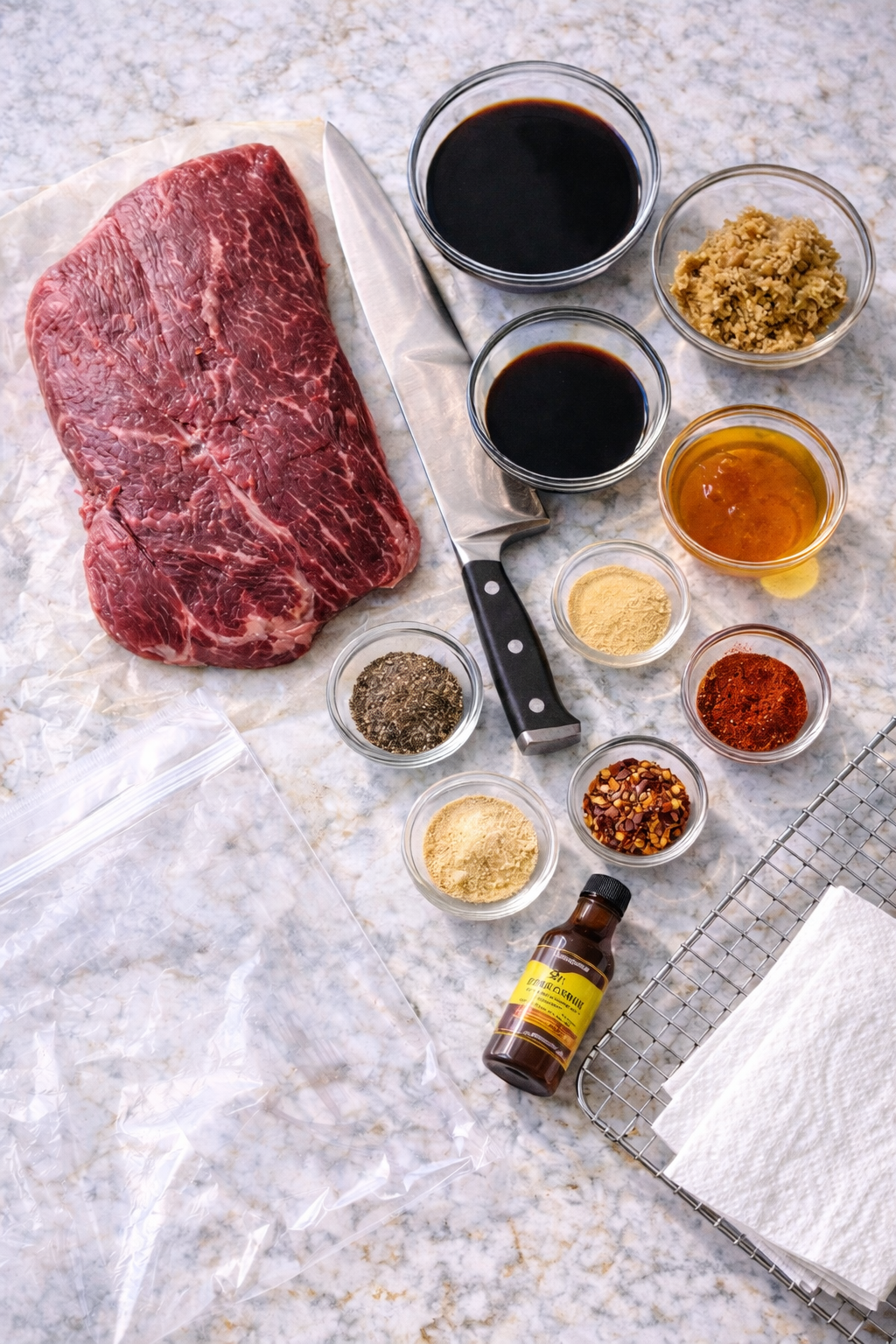
$47 for a 12-ounce bag.
That’s what I almost paid at a specialty store last week. For jerky.
I put it back and walked straight home to make my own batch for less than $20. Same amount, better flavor, zero weird preservatives.
Here’s the thing about store-bought jerky: it’s either loaded with sugar, dry as cardboard, or costs more per pound than actual steak.
When you make it at home?
You get thick, chewy pieces packed with flavor. You know every single ingredient. And you can customize it to be as spicy, sweet, or smoky as you want.
I’m walking you through the whole process. By the end of this, you’ll have a freezer full of jerky that’ll make those gas station bags look like a sad joke.
Store-Bought vs. Homemade: The Real Numbers
| Store-Bought | Homemade | |
|---|---|---|
| Cost per pound | $35-65 | $12-18 |
| Ingredients you can pronounce | Maybe 5 | All of them |
| Sugar content | 6-12g per serving | You decide |
| Texture | Often dry/hard | Perfectly chewy |
| Flavor control | Take it or leave it | Endless options |
| Satisfaction level | Meh | Chef’s kiss 👨🍳 |
The math alone makes it worth trying once.
What You’ll Need
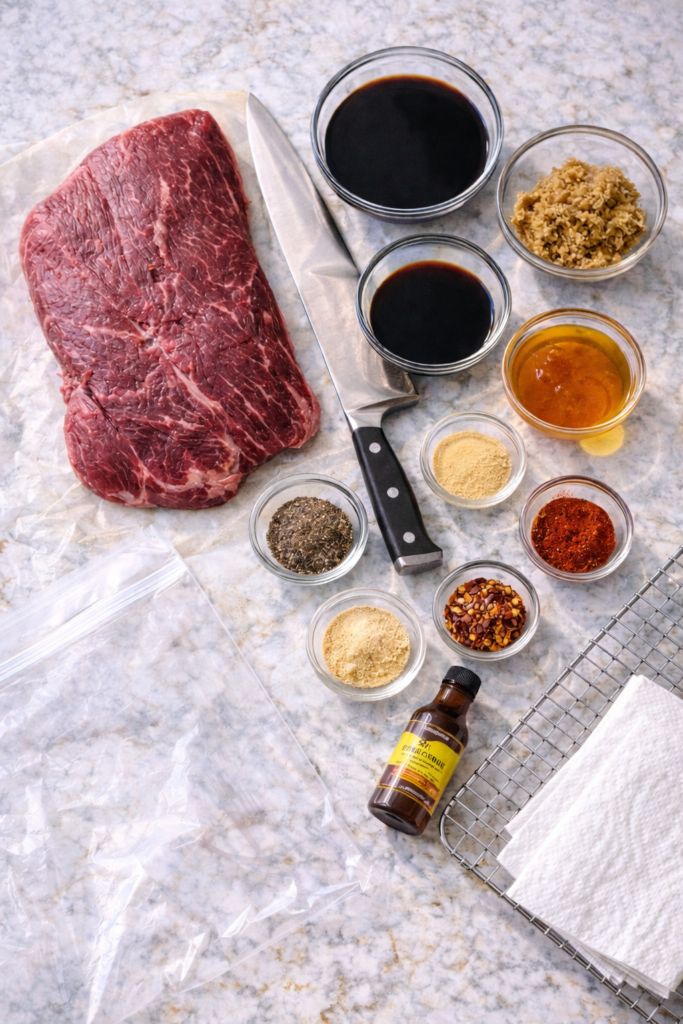
The Meat (This Is Critical)
Best cuts for jerky:
- Flank steak (my favorite)
- Top round
- Eye of round
- Sirloin tip
What to look for: Lean cuts with minimal marbling. Fat = shorter shelf life and chewy bits you don’t want.
Quick tip: Tell your butcher you’re making jerky. Most will trim and slice it for free or a small fee. Saves you 20 minutes and ensures perfect thickness.
The Marinade
| Ingredient | Amount | Why It Matters |
|---|---|---|
| Soy sauce | 1/2 cup | Salty base + umami depth |
| Worcestershire sauce | 1/4 cup | Tangy complexity |
| Brown sugar | 2 tbsp | Balances salt, helps with texture |
| Honey | 2 tbsp | Natural sweetness + slight stickiness |
| Black pepper | 2 tsp | Adds bite |
| Garlic powder | 2 tsp | Savory backbone |
| Onion powder | 2 tsp | Rounds out the flavor |
| Smoked paprika | 1 tsp | Subtle smokiness |
| Red pepper flakes | 1 tsp | Heat (optional) |
| Liquid smoke | 1/2 tsp | Campfire vibes without the campfire |
Your Jerky-Making Arsenal
Must-haves:
- 🔪 Sharp knife (or butcher’s help)
- 🥡 Large zip-top bags or shallow dish
- 🌡️ Dehydrator, oven, or smoker
- 📏 Wire racks (for oven method)
- 🧻 Paper towels
Nice-to-haves:
- Vacuum sealer (keeps jerky fresh for months)
- Meat slicer (if you’re getting serious about this)
- Silica gel packets (for storage)
Pro Tips From Someone Who’s Made 50+ Batches
💡 Tip #1: The Freezer Hack
Freeze your steak for 1-2 hours before slicing.
This is the difference between perfectly thin slices and a hacked-up mess. Partially frozen meat slices like butter.
Target thickness: 1/8 to 1/4 inch. Any thicker and you’re waiting forever for it to dry. Any thinner and it’ll turn into meat chips.
💡 Tip #2: Against the Grain vs. With the Grain
Look at your meat. See those lines running through it? That’s the grain.
Slice against the grain: Tender, easier to bite jerky (my preference)
Slice with the grain: Chewier, more traditional texture
Pro move? Do half and half. See which one you like better.
💡 Tip #3: Marinate Like You Mean It
Minimum marinating time: 6 hours
Sweet spot: 12-24 hours
Maximum: 48 hours
The longer it sits, the deeper the flavor. I usually start mine the night before and let it go for 18-20 hours.
Marinating hack: Flip the bag every few hours so all the pieces get equal time in the liquid.
💡 Tip #4: Pat It Dry (Seriously)
After marinating, use paper towels to blot off excess marinade.
If you skip this step, your jerky will be too salty and take forever to dry. Plus it’ll be sticky instead of having that perfect chewy texture.
Quick test: If the meat feels wet to the touch, keep blotting.
💡 Tip #5: The Bend Test
Your jerky is done when it bends and cracks but doesn’t snap in half.
- Snaps clean through = overdone and too dry
- Bends with no resistance = underdone, needs more time
- Bends and cracks slightly = perfect
Let it cool completely before testing. It firms up as it cools.
How to Make Beef Jerky (Step by Step)
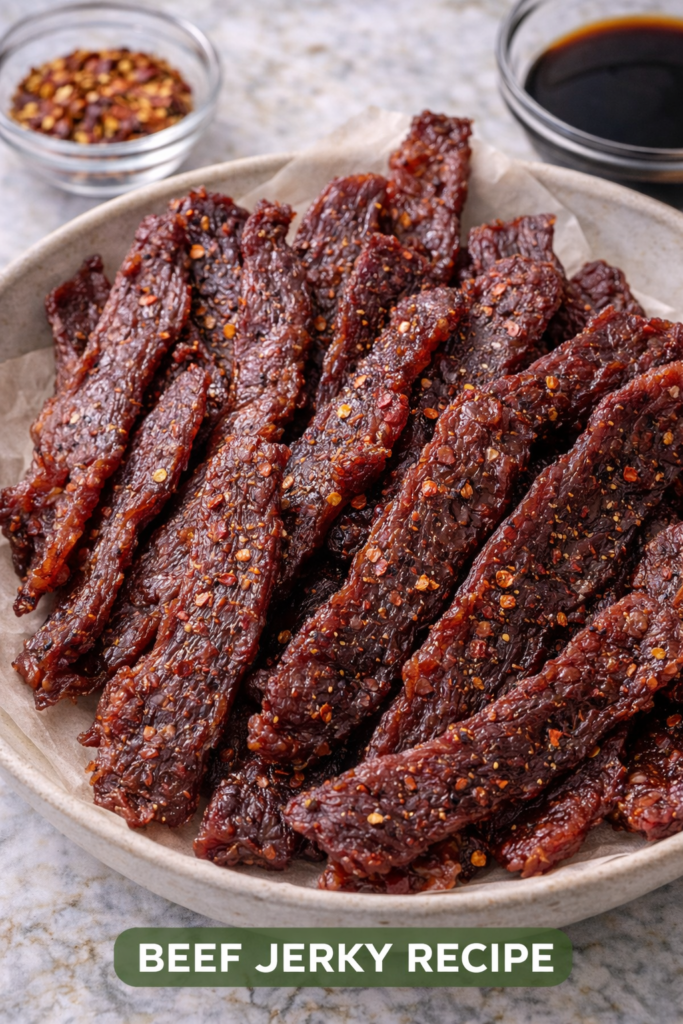
Step 1: Prep the Meat
Trim off any visible fat. Fat doesn’t dehydrate well and makes your jerky spoil faster.
Slice your partially frozen meat into thin strips (1/8 to 1/4 inch).
Not confident with a knife? Most butchers will slice it for you if you ask. Some even do it for free.
Step 2: Mix Your Marinade
Whisk everything together in a bowl:
- Soy sauce
- Worcestershire sauce
- Brown sugar
- Honey
- All the spices
Taste test: It should be salty and strong. The meat will dilute it, so don’t worry if it seems intense.
Step 3: Marinate the Meat
Drop your sliced meat into a large zip-top bag. Pour in the marinade.
Squeeze out as much air as possible and seal it up tight.
Refrigerate for at least 6 hours (overnight is better).
Pro move: Flip the bag every few hours to redistribute the marinade.
Step 4: Dry the Meat (Choose Your Method)
Pat each piece dry with paper towels first. This is non-negotiable.
🔥 Dehydrator Method (Easiest)
| Setting | Time | What to Watch For |
|---|---|---|
| 160°F | 4-6 hours | Check every hour after 4 hours |
Arrange strips in a single layer. Don’t let them touch or overlap.
🔥 Oven Method (Most Common)
Temperature: 170-200°F (lowest setting)
Time: 3-5 hours
Setup: Line baking sheets with foil, place wire racks on top, arrange meat in single layer
Critical step: Prop the oven door open with a wooden spoon to let moisture escape.
Flip strips halfway through.
🔥 Smoker Method (Most Flavorful)
Temperature: 160-180°F
Time: 3-4 hours
Wood: Hickory, mesquite, or applewood
Place strips directly on grates. Check for doneness starting at 3 hours.
Step 5: Test for Doneness
Pick up a piece. Let it cool for 30 seconds.
Bend it.
Perfect jerky: Bends and cracks but doesn’t snap
Underdone: Bends easily with no resistance
Overdone: Snaps clean in half
Let it cool completely. It’ll firm up more as it cools.
Substitutions and Variations
Meat Options
| Cut | Fat Content | Texture | Best For |
|---|---|---|---|
| Flank steak | Low | Tender | Beginners |
| Top round | Very low | Chewy | Traditional jerky lovers |
| Eye of round | Very low | Firm | Long shelf life |
| Sirloin tip | Low | Tender | Rich flavor |
| Ground beef (90% lean) | Medium | Dense | No slicing needed |
| Turkey breast | Very low | Light | Lower calorie option |
| Venison | Very low | Gamey | Adventurous eaters |
Flavor Variations (Because Plain Gets Boring)
🌶️ Spicy Chipotle
- Replace liquid smoke with 2 tbsp adobo sauce
- Add 1 tsp chipotle powder
- Double the red pepper flakes
Result: Smoky heat that builds with each bite
🍯 Sweet Teriyaki
- Swap Worcestershire for teriyaki sauce
- Add 1 tbsp fresh grated ginger
- Increase honey to 1/4 cup
Result: Sweet, sticky, addictive
🧈 Maple Bourbon
- Add 3 tbsp bourbon
- Replace honey with maple syrup
- Add 1/2 tsp cinnamon
Result: Sophisticated, slightly sweet, campfire-worthy
🌿 Garlic Herb
- Double the garlic powder
- Add 1 tbsp dried rosemary
- Add 1 tbsp dried thyme
- Skip the liquid smoke
Result: Earthy, aromatic, not your typical jerky
🔥 Korean BBQ
- 1/4 cup soy sauce
- 2 tbsp sesame oil
- 3 tbsp brown sugar
- 2 tbsp gochugaru (Korean chili flakes)
- 1 tbsp grated ginger
- 2 tsp sesame seeds
Result: Sweet, spicy, nutty perfection
🍋 Citrus Pepper
- Add zest of 2 limes
- Add 2 tbsp lime juice
- Triple the black pepper
- Reduce soy sauce to 1/3 cup
Result: Bright, tangy, peppery kick
Real talk: The marinade is where the magic happens. Don’t be scared to experiment. The worst that can happen? You make a batch that’s just okay. The best that can happen? You create your signature flavor that people beg you to make.
Make Ahead Tips
Meal Prep Timeline
| When | What to Do | How Long It Keeps |
|---|---|---|
| 2 days before | Slice and marinate meat | Up to 2 days in fridge |
| 1 week before | Mix marinade (without meat) | Up to 1 week in fridge |
| After making | Store finished jerky | See storage guide below |
Batch cooking hack: Make a triple batch. Keep one for now, freeze two for later. Your future self will thank you.
Leftovers and Storage (Make It Last)
Storage Times by Method
| Storage Method | How Long | Best For |
|---|---|---|
| 🌡️ Room temperature (airtight container) | 1-2 weeks | Quick snacking |
| ❄️ Refrigerator (airtight container) | 1-2 months | Regular eating |
| 🧊 Freezer (vacuum sealed) | 6+ months | Long-term storage |
My Favorite Storage Hacks
For room temperature storage:
- Use an airtight container
- Toss in a silica gel packet (like the ones in vitamin bottles)
- Keep it in a cool, dark place
For fridge storage:
- Zip-top bags work great
- Write the date on the bag
- Stack them to save space
For freezer storage:
- Vacuum seal if you have one (game changer)
- Or use freezer bags with air squeezed out
- Portion it into single servings for easy grabbing
When to Toss It
Your jerky has gone bad if it:
- Smells off or sour
- Gets slimy or sticky (not in a good way)
- Develops mold (white, green, or fuzzy spots)
- Tastes funky
Real talk: If you store it properly, you’ll eat it way before any of this happens.
Frequently Asked Questions
Do I need a dehydrator to make beef jerky?
Nope. Your oven works perfectly fine.
The only catch: you need to prop the door open to let moisture escape, and it takes a bit longer.
Dehydrator pros: More energy efficient, set it and forget it
Oven pros: You already own one
Can I make jerky without liquid smoke?
Absolutely. It’s totally optional.
Liquid smoke adds a campfire flavor, but your jerky will still be delicious without it. I skip it half the time.
How do I know when the jerky is done?
The bend test.
Pick up a piece. Bend it. It should crack slightly but not break clean through.
Too bendy: Needs more time
Snaps in half: Overdone
Bends with a crack: Perfect
Why is my jerky too salty?
You didn’t pat the meat dry enough after marinating.
That excess marinade sitting on the surface makes it too salty and takes forever to dry.
Next time: Really blot it with paper towels. Like, aggressive blotting.
Can I use a different type of meat?
Yes. Jerky works with:
- Venison (lean and gamey)
- Bison (rich and tender)
- Turkey (lighter, less calories)
- Chicken (mild flavor)
Just stick with lean cuts and trim visible fat.
Is homemade jerky safe to eat?
As long as you hit 160°F during dehydrating (which you will), it’s completely safe.
That temperature kills any bacteria. Just use clean equipment and store it properly.
Food safety tip: If you’re using ground meat, make sure you cook it to 160°F before dehydrating.
How much does homemade jerky cost compared to store-bought?
Way cheaper.
The math:
- 2 lbs raw meat = about 8 oz finished jerky
- Total cost: $15-20
- Same amount at the store: $30-50
You’re saving 50% minimum. And it tastes better.
Can I add more sweetness to the jerky?
For sure. Just increase the honey or brown sugar.
Fair warning: Sweeter marinades can caramelize during drying. It’s delicious but makes the jerky stickier.
If you want it sweet without the stick, add a bit more sugar to the marinade but pat it dry really well.
What if I don’t have a wire rack for the oven method?
You can lay the strips directly on the oven rack.
Pro tip: Put a baking sheet lined with foil on the rack below to catch any drips.
Or invest in a $10 wire rack. You’ll use it for so many things beyond jerky.
How do I make it less chewy?
Slice thinner (closer to 1/8 inch) and slice against the grain.
Also, don’t over-dry it. The bend test is your friend.
Can I make jerky if I have dietary restrictions?
Gluten-free: Use tamari instead of soy sauce
Low-sodium: Use low-sodium soy sauce and reduce to 1/3 cup
Sugar-free: Skip the honey and brown sugar, use a sugar-free sweetener
Paleo: Use coconut aminos instead of soy sauce
Nutrition Info (Because It Matters)
Homemade Jerky vs. Store-Bought
| Nutrient (per 1 oz) | Homemade | Store-Bought |
|---|---|---|
| Calories | 80-100 | 80-120 |
| Protein | 12-15g | 9-12g |
| Sugar | 2-4g | 6-12g |
| Sodium | 300-400mg | 500-700mg |
| Weird additives | 0 | Too many to count |
The takeaway: You control what goes in. That alone is worth making it yourself.
Troubleshooting Guide
Problem: Jerky is too tough
Possible causes:
- Sliced too thick
- Over-dried
- Cut with the grain when you wanted tender
Fix for next time: Slice thinner, check doneness earlier, cut against the grain
Problem: Jerky is too soft/chewy
Possible causes:
- Didn’t dry long enough
- Too much fat in the meat
- Marinade was too wet
Fix: Put it back in the dehydrator/oven for another hour. Pat the meat drier next time.
Problem: Jerky tastes too salty
Possible causes:
- Didn’t blot the marinade off well enough
- Marinated too long (more than 48 hours)
Fix: Blot more aggressively. Reduce marinade time.
Problem: Jerky is sticky
Possible causes:
- Too much honey/sugar in marinade
- Didn’t dry completely
- Stored while still warm
Fix: Let it cool completely before storing. Reduce sweeteners next time.
Wrapping Up
Here’s what I want you to remember: making beef jerky at home isn’t some complicated chef thing.
It’s slicing meat, soaking it in a marinade, and letting it dry. That’s it.
You’ll save money. You’ll know exactly what you’re eating. And you’ll have snacks that actually taste good instead of like cardboard with MSG.
Start with the basic recipe I gave you. Get one batch under your belt. Then play around with the flavors. Make it spicier. Make it sweeter. Add bourbon. Add citrus. Make it yours.
The first batch might not be perfect. Mine definitely wasn’t. But the second batch? The third? You’ll figure out your groove.
And once you do, you’ll never look at those overpriced gas station bags the same way again.
Now it’s your turn.
Try this recipe. Come back and tell me how it went. What marinade did you use? How did the texture turn out? Any tweaks you’d recommend?
Drop a comment below. I read every single one.